In this guide
- 01Is January a good month?
- 02January weather, region by region
- 03Snow, Sela Pass and the road
- 04What January does best
- 05Festivals and local life
- 06Three ways to plan your trip
- 07A seven-day itinerary
- 08Packing, health and altitude
- 09Permits, bookings and timing
- 10Your questions answered
- 11Begin your journey
Ask ten people about an Arunachal Pradesh tour in January and you will hear the same two worries: will it be too cold, and will the road to Tawang be open? Both are fair questions, and neither is a reason to stay home. January is when the air over the eastern Himalaya is at its driest and cleanest, when the sky behind the peaks turns a hard, bright blue and when the summer crowds are nowhere to be seen. It is also the month when one night of snow on a high road can rewrite your whole day.
So this guide does not try to sell you a perfect picture. It tells you what Arunachal in January actually feels like, region by region, which places repay the cold and which ones quietly disappoint, and how to build a route with enough slack that the weather becomes part of the story instead of the end of it. If you would rather skip the reading, send us your dates and we will draft a route by hand.
“January hides nothing. The fields are bare, the air is thin and the light is honest, so you dress for it, plan for it and enjoy it.”
Section 01
Is January a good month for Arunachal Pradesh?
It depends on what you want from the trip. January rewards travellers who like clear air, quiet roads and a slower rhythm, and it frustrates those who arrive hoping for green terraces and thundering waterfalls. Use the two lists below as a quick, honest test.
Choose January if…
- You prefer sharp mountain views to lush greenery.
- Cold evenings, a warm room and an early night sound pleasant rather than punishing.
- You would like to catch cranes at Sangti, a monastery festival or a dusting of snow on distant ridges.
- You can keep one spare day in the plan.
Wait for spring if…
- You are picturing green paddy fields, flowering orchards or full waterfalls.
- Your flight home leaves the same evening you return to Guwahati.
- Someone in the group struggles with cold or altitude and has not spoken to a doctor.
- You need certainty about reaching Bum La or high lakes, where snow makes the final call.
Spring and autumn are the usual alternatives for the western circuit, and our overview of Arunachal Pradesh tour packages compares the options. January sits apart from both: colder, quieter and, for the right traveller, more memorable.
Section 02
January weather in Arunachal Pradesh, region by region
Altitude does most of the work here. Bhalukpong sits at roughly 200 metres, Dirang around 1,500, Bomdila above 2,400 and Tawang between about 2,700 and 3,000 metres, depending on which part of town you are standing in. One day’s drive can take you from a mild afternoon to a night well below freezing. The table gives a feel for each stop. Treat it as a guide to what to expect, not a forecast.
| Place | Height (approx.) | What January feels like | Pack for |
|---|---|---|---|
| Bhalukpong and Tezpur side | About 200 m | Cool mornings, mild afternoons and a chance of early fog | Light woollens and an evening jacket |
| Dirang and Sangti | About 1,500 m | Frosty mornings, pleasant sunny middays and cold evenings | Layers plus a warm jacket for dawn outings |
| Bomdila | Above 2,400 m | Properly cold, with nights that can fall to around freezing or lower | Thermals, down jacket, cap and gloves |
| Tawang | About 2,700–3,000 m | The coldest base on the circuit: sub-zero nights, bright dry days and a chance of snow | Full winter kit, including boots with grip |
| Sela Pass area | About 4,170 m | Snow and ice are likely, with wind and short stops | Everything you have, worn in layers |
| Ziro Valley | About 1,500–1,700 m | Frosty dawns, dry sunny afternoons and bare harvested fields | Warm layers, with thermals for early starts |
Mornings are often foggy in the foothills and around Bomdila, so views can open late. January is the driest stretch of the year, but a passing winter system can bring rain low down and snow higher up. Check the forecast for the week you travel, and remember that mountain weather changes faster than any app.
Section 03
Snow, Sela Pass and the road to Tawang
The road question deserves a straight answer. The route to Tawang crosses the Sela range, and the pass itself, at about 4,170 metres, collects heavy snow in winter. Since the Sela Tunnel opened roughly 400 metres below the pass, winter access to Tawang has become far more dependable than it used to be.
The tunnel, however, does not change the weather on either side of it. Snow, black ice and landslides on the approaches can still slow traffic for hours, and occasionally for longer. That is why a good January itinerary is built around a margin rather than a deadline.
What this means for your plan
- Keep the day you come down from Tawang separate from the day you fly or take a train home.
- Start early. In the hills the light fades shortly before five in the evening, and careful drivers avoid mountain roads after dark in winter.
- Keep water, snacks and a warm layer inside the vehicle, not buried in the boot.
- If your driver says wait, wait. Road crews clear the route as quickly as conditions allow, and local judgement is worth more than an optimistic schedule.
Places that depend on the snow
Bum La, Sangetsar (Madhuri) Lake and other high spots beyond Tawang may be closed or unreachable after snowfall. Bum La also needs separate permission whatever the weather. Plan your Tawang days so the best moments, the monastery, the town and the valley light, never depend on them.
Section 04
What January does best: places and moments
Winter strips Arunachal down to its essentials, and some places look better for it. These are the stops that earn their place on an Arunachal Pradesh tour in January, followed by the ones where it pays to lower your expectations.
Dirang · West Kameng
Black-necked cranes at Sangti
Black-necked cranes, which breed on the Tibetan plateau, winter on the harvested fields around Sangti and a few neighbouring valleys. They generally arrive around late November or early December and leave by early February, so January falls inside the window. Numbers are small, some years they leave early and tourist disturbance has been a real concern. Go at first light, keep your distance, stay quiet and follow local guidance. Treat a sighting as a bonus, never a promise.
Tawang · Tawang district
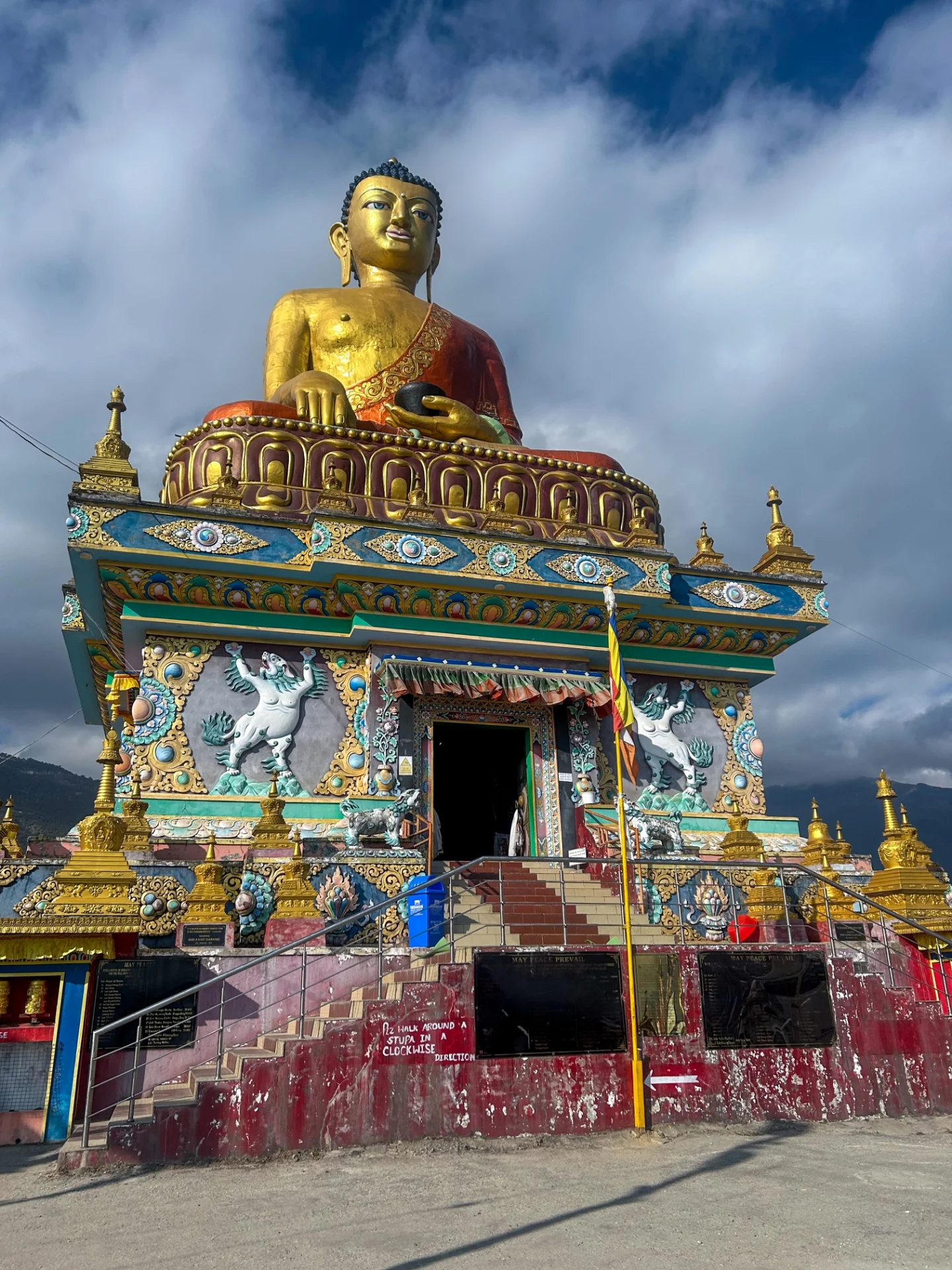
Tawang Monastery in winter light
Often described as the largest monastery in India, it sits on a hillside above the town. January sun is low and sharp, which suits its prayer halls and wide courtyard, and the crowds are thinner than in the busy seasons. Ask your host about prayer times and visit with the same respect you would bring to any place of worship.
Dirang · West Kameng
Hot springs, dzong and stone lanes
Dirang has natural hot-water springs, a treat that suits a cold January evening better than any summer one. Check current access and condition locally before you plan around them. By day, walk the old dzong, the stone-walled Monpa lanes and the river path, and let the pace drop.
Bomdila · West Kameng
Monastery, viewpoint and craft stops
Bomdila’s orchards are bare in January, but the monastery, the hill views above town and the local craft stops reward visitors who like sightseeing unhurried. At around 2,400 metres it also makes a sensible first night before Tawang.
Tawang district
Urgelling and the war memorials
Urgelling Monastery, the birthplace of the Sixth Dalai Lama, is a short drive from Tawang town. The Tawang War Memorial and the Jaswantgarh memorial on the road from Sela add a quiet chapter of history to the route.
Ziro Valley
Ziro in winter
After the autumn harvest the Apatani fields lie bare and the valley turns crisp, sunny and smoky with morning woodsmoke. Walk with a local host through a village such as Hong or Hari by arrangement, and enjoy the pine ridges. The green-paddy postcard is a July photograph, so come in January for the quiet.
Where to lower your expectations
- Nuranang (Jang) Falls: the flow is usually lighter in winter and the surroundings cold and slippery, but it is still worth a careful stop.
- Orchards and blossom: apple and kiwi trees are bare in January.
- Ziro’s paddy fields: expect stubble and bare earth, not green terraces.
- Lakes and passes at height: frozen, snowy or closed, depending on the week.
What you will eat when it is cold
January is the season for steaming bowls. Expect thukpa and momos in the Monpa towns, salted butter tea, chhurpi (hard yak cheese) as a trail snack and warming millet-based dishes. In Ziro, ask about bamboo-shoot dishes and apong, the rice beer Apatani families brew at home. Ask before photographing a kitchen or a family gathering.
Section 05
January festivals and local life
Timing a trip around a festival can make an Arunachal Pradesh tour in January unforgettable, but it can also fill every room in town. Decide which kind of trip you want before you choose dates.
Torgya at Tawang Monastery
Torgya is a three-day monastic festival built around masked dances, known as cham, in the monastery courtyard, performed to ward off misfortune and welcome a peaceful year. It follows the Monpa lunar calendar, so the dates move: reports from different years place it anywhere from the second week of January to the last. Confirm the dates before you lock flights, and expect crowded rooms in Tawang on festival days. If you want the spectacle, book early. If you want silence, avoid those days.
Magh Bihu on the way in
Around the middle of January, Assam celebrates Magh Bihu with feasts and bonfires. If you start from Guwahati or Tezpur, some shops and services may keep shorter hours, so ask your operator how it affects your first and last days.
Pangsau Pass Winter Festival, far to the east
Nampong in Changlang district, close to the Myanmar border, has traditionally hosted a three-day winter festival in the third week of January. It lies in eastern Arunachal, a very long way from Tawang, so treat it as a separate journey and check that it is being held before you plan around it.
Losar, the Monpa new year, falls later, in February or March, so January is not the month for it.
Section 06
Three ways to plan an Arunachal Pradesh tour in January
These are starting points rather than fixed packages. Each one follows winter logic: sleep lower before you climb, finish the long drives in daylight and keep a day in hand. We do not list fixed rates here because they depend on your dates, group size and hotels, so ask for a written quote shaped around your plans.
-
6 Nights · 7 Days
Western circuit, seven days
Guwahati · Bomdila · Dirang · Tawang
Suits: First-time visitors comfortable with cold and long drives
- Two gentler nights before Tawang, so you climb gradually
- Three nights in Tawang with one flexible day
- Cranes at Sangti and a Dirang soak on the way
-
4 Nights · 5 Days
Dirang and Bomdila, five days
Tezpur · Dirang · Bomdila
Suits: Families, older travellers and anyone short on leave
- Cranes, hot springs and monasteries without Tawang’s altitude
- Shorter drives and lower overnight stops
- A realistic first taste of the western hills
-
4 Nights · 5 Days
Ziro in winter, five days
Itanagar · Ziro
Suits: Couples and photographers who want a quiet valley
- Hosted village walks and pine-ridge views
- No high snow pass on the way
- Warm rooms, quiet evenings and local food
Travelling as a couple? Any of these routes works for a winter honeymoon. Ask for a room with a view and reliable heating, and we will tell you what can be arranged at each stay.
Want something different altogether? Browse the wider range of Arunachal Pradesh tour packages, or tell us what you have in mind.
Section 07
A seven-day Arunachal Pradesh tour in January
Here is how the western circuit looks when it is planned for winter. It climbs slowly, keeps one flexible day in Tawang and ends in Guwahati with a full night to spare before any onward travel. Sightseeing depends on weather, road access and how everyone feels at altitude, so treat each day as a plan with room to bend.
-
Day 01 · Arrival
Guwahati → Bomdila
Leave Guwahati at first light for the long climb into the western hills. Break for lunch in the foothills and aim to reach Bomdila before the light fades. Settle in, eat early and sleep. Pushing on to Dirang on the first day would stretch an already long drive. Overnight in Bomdila.
-
Day 02 · Down to Dirang
Bomdila Monastery and Dirang
Spend the morning at Bomdila’s monastery and viewpoint, then drive down to Dirang, a gentler 1,500 metres. Walk the old dzong and village lanes in the afternoon sun and, if access allows, finish with a soak in the hot springs. Overnight in Dirang.
-
Day 03 · To Tawang
Sangti at dawn, then the mountain road
Visit Sangti Valley at first light for a chance of cranes, then drive towards Tawang over the Sela range and through the tunnel. Stop at the Jaswantgarh memorial and, if conditions are safe, at Nuranang Falls near Jang. Arrive before dark and rest. Overnight in Tawang.
-
Day 04 · Tawang
Monastery, town and Urgelling
Visit Tawang Monastery in the morning light, then walk through town and pay your respects at the Tawang War Memorial. Drive out to Urgelling Monastery in the afternoon. Keep the pace slow, because the altitude is the main activity. Overnight in Tawang.
-
Day 05 · Tawang
The flexible day
Weather chooses today. If the road is clear and permissions are in place, go for a high lake or a border-side viewpoint. If not, rest, browse the market, sit with tea and return to the monastery. Any Bum La visit needs separate approval and is never guaranteed. Overnight in Tawang.
-
Day 06 · The long way down
Tawang → Bomdila
Start after an early breakfast for the long drive back, with rest stops and the viewpoints you missed on the way up. Keep the evening quiet. Overnight in Bomdila.
-
Day 07 · Departure
Bomdila → Guwahati
Drive down to the plains and allow generous time for road delays. Do not book a same-evening flight or train; a night in Guwahati keeps the final day calm. The six-night journey ends here.
Section 08
Packing, health and altitude
Good kit decides whether an Arunachal Pradesh tour in January feels like an adventure or an endurance test. Think layers, not bulk.
What to pack
- Thermal tops and bottoms for base layers
- A fleece or wool mid-layer
- A proper down or padded jacket, plus a windproof shell
- Woollen cap, gloves and a neck warmer
- Thick socks, with spares
- Waterproof boots with real grip, since smooth soles slip on ice
- Sunglasses and sunscreen, because snow glare and thin air burn quickly
- Moisturiser and lip balm for dry, cold air
- A power bank kept inside your jacket, since cold drains batteries
- A torch or headlamp for power cuts
- Your usual medicines, ID and permit copies
Looking after yourself
- Climb gradually. Tawang sits close to 3,000 metres and the road crosses 4,000, so headaches, nausea and poor sleep can appear.
- Drink water often, eat light on arrival and skip heavy alcohol on the first night.
- Tell your driver or host at once if symptoms worsen. Going lower is the safest response.
- Speak to your doctor beforehand if you have heart, lung or blood-pressure concerns, are pregnant or are travelling with infants or elderly relatives.
- If a room uses a charcoal or wood heater, keep a window slightly open and never sleep with an unvented fire.
- Ask about hot-water timings and backup power when you book.
A good hotel in Tawang or Bomdila should be able to tell you exactly how its rooms are heated. If the answer is vague, choose another.
Section 09
Permits, bookings and timing
Indian visitors need an Inner Line Permit and foreign visitors need a Protected Area Permit. The Inner Line Permit can usually be applied for online through the state government’s official portal or through the state’s liaison offices, and we can help with the paperwork. Rules change, so confirm the current process before you book and carry the approved permit with your identity documents.
Winter dates are less predictable than summer ones, but the days around New Year and any Torgya dates are likely to be busier, and heated rooms are limited. Winter fog can also delay flights into Guwahati, so avoid tight connections at either end.
Planning in six steps
-
Choose one region
Pick the western circuit, Dirang and Bomdila, or Ziro. Combining far-apart regions needs more time than January daylight allows.
-
Fix your dates around weather and festivals
Decide whether you want the crowds and colour of Torgya or quieter days, and check the festival dates before you book.
-
Apply for permits early
Share names and nationality so permits can be arranged before departure.
-
Build in a spare day
Keep a flexible day in Tawang and a full night before any onward travel.
-
Confirm heating and rooms
Ask each hotel how rooms are heated and what happens during a power cut.
-
Pack for the cold and ease into altitude
Prepare layers, boots and medicines, and climb gradually.
Section 10
Arunachal Pradesh tour in January: your questions answered
Is January a good time to visit Arunachal Pradesh?
Yes, for travellers who want clear, cold, quiet mountain days and can keep the plan flexible. January is among the driest months, views are often sharp and crowds are thin. It is a poor choice if you want green fields, full waterfalls or a rigid timetable. Tawang and Bomdila are properly cold, Dirang is chilly and Ziro is crisp, so choose your region to match your comfort in cold weather.
Will it snow in Tawang in January?
Snow is possible in and around Tawang, and likely at the Sela Pass, but no operator can promise it on a given date. Some years bring heavy falls, others only a dusting. Do not book a trip around the chance of snow alone. Choose it for the clear light, the monasteries and the quiet, and treat snow as a bonus.
Is the road to Tawang open in January?
The route is generally open, and the Sela Tunnel, which sits roughly 400 metres below the pass, has made winter travel far more dependable. Snow, ice and landslides on the approaches can still cause delays or temporary closures. Start early, keep a spare day at the end of the trip and follow your driver’s advice about when to move.
Is an Arunachal Pradesh tour in January suitable for children and older travellers?
It can be, with the right route. A Dirang and Bomdila itinerary or a Ziro stay keeps altitude and driving days gentler than a full Tawang circuit. Check heating, hot water and vehicle comfort in advance, and speak to your doctor about cold and altitude before you confirm.
Which is better in January, Tawang or Ziro?
Tawang offers monasteries, mountain roads and real winter atmosphere, with colder nights and more weather risk. Ziro is gentler, sunnier at midday and easier on the road, with village walks and quiet evenings. Pick Tawang for the full Himalayan experience and Ziro for a calm break. They lie in different parts of the state, so each needs its own itinerary.
How many days do I need for an Arunachal Pradesh tour in January?
Allow seven days for the western circuit to Tawang, including a flexible day. Four to five days suit a Dirang and Bomdila break or a Ziro stay. Winter daylight is short and roads can be slow, so do not squeeze Tawang into a long weekend.
Can I see black-necked cranes in January?
Possibly. The cranes usually arrive in Sangti Valley around late November or early December and leave by early February, so January falls inside their stay. Numbers are small and sightings are never guaranteed. Visit at first light, keep your distance, stay quiet and follow local guidance so the birds are not disturbed.
Do I need a permit for a January trip to Arunachal Pradesh?
Indian visitors need an Inner Line Permit and foreign visitors need a Protected Area Permit. Requirements depend on nationality and route, so confirm the current process before you book. Carry the approved permit and identity documents. Bum La and other restricted excursions need separate approval, which is never guaranteed.
Section 11
Begin your journey
Tell us when you plan to travel, who is coming and where you would like to arrive, and we will turn this guide into a route with the hotels, drive times and spare day written out for you to review. There is no obligation, and prices are shared only in your written quote.
Share your plans through the enquiry form on our bespoke journeys page, or call the concierge on +91 98744 08179. If you are still comparing, read our overview of Arunachal Pradesh tour packages first.